A Second Pass Through a Short Text
A second pass through a short text helps you test its main claim against the wording that carries it, without turning a free afternoon into homework.
What changes when you read a short text again, instead of simply moving on? A second pass through a short text can reveal whether its most memorable claim is actually supported by the sentences around it. Set aside a free afternoon, choose a piece you can finish without rushing, and give the reread one narrow purpose: check how a single passage makes the main claim persuasive, qualified or less certain.
1. Choose a text that rewards attention
Pick an essay, review, short story, speech or compact chapter that left you with a clear impression but a few loose ends. The text should be short enough to reread comfortably, yet substantial enough to contain a claim and some meaningful choices of wording. A piece you barely remember may call for an ordinary first reading; one you already know by heart may offer too little surprise.
Choose for a reason you can name. Perhaps an essay sounded confident while its evidence felt thin, or a story’s final paragraph changed how you understood an earlier scene. That small question gives your afternoon direction. It also keeps the exercise distinct from collecting notes for a future project or trying to extract a grand lesson from every page.
Leave other reading within reach, but out of view. A notebook, pencil or blank document is enough for the record; avoid turning preparation into a search for the perfect pen or reading app. What is not worth the effort is building an elaborate system of colour-coded marks before you know what you are looking for.
2. Read once for the claim, not the details
On the first pass, read at a natural pace. Do not stop to annotate every striking phrase. When you finish, write a plain sentence stating what you think the text is chiefly claiming. Keep it in your own words, and make it specific enough to disagree with.
“The writer discusses public libraries” is a topic, not a claim. “Libraries matter because they offer useful space beyond borrowing books” takes a position. If the text is a story rather than an argument, phrase the claim as the central idea it seems to invite: for instance, “The story suggests that a polite exchange can hide a refusal.” You are recording your first understanding, not settling the text’s meaning for good.
Add one brief note about your confidence. You might write “fairly sure” or “not sure whether this is the main point”. This gives you something to compare with your second reading. Resist the urge to draft a full review; a long first response can make it harder to notice where the text itself surprises you.
3. Find one passage that carries weight
Return to the text and locate a passage that seems especially important to your claim. It might define a term, introduce evidence, make a concession, shift the tone or supply the image that lingers in your memory. Choose one passage rather than gathering a page of quotations. The limit makes close attention possible.
Look at what happens just before and after it. A sentence may sound decisive alone, then turn out to be an example rather than the writer’s conclusion. A qualification may arrive later. In a story, a line that first seemed simple may take on a different colour when an earlier detail is brought back into view. Context helps you see the passage doing its actual work, rather than the work your memory assigned to it.
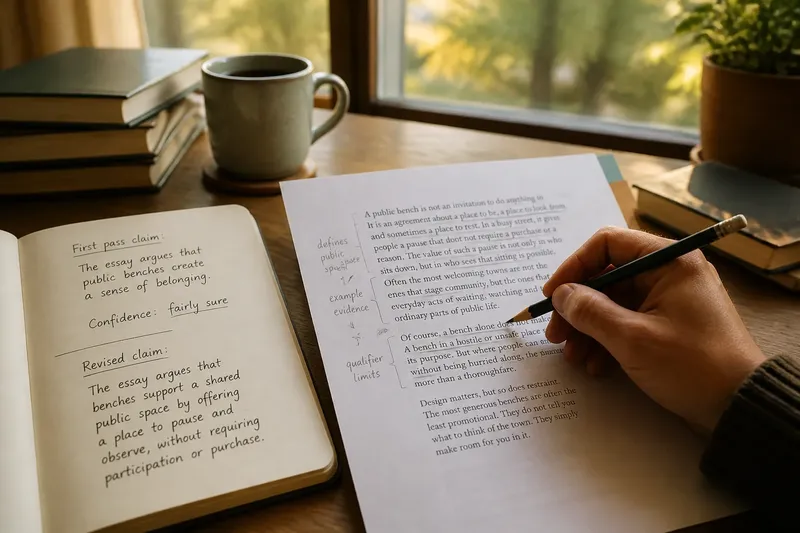
Say you read a short essay arguing that public benches help make a town welcoming. On the first pass, you write, “The essay says benches create a sense of belonging.” During the reread, you choose a paragraph describing a bench outside a busy shop. If its wording focuses on somewhere to pause and observe rather than on meeting other people, you may decide the essay’s support is more about shared public space than belonging itself. The observable result is a revised claim in your notes, not a verdict on every town or every bench.
4. Examine what the wording is doing
Read the selected passage slowly enough to notice its choices. Mark only words or phrases that help explain how it supports, narrows or complicates your claim. A few marks in the margin are usually clearer than highlighting whole paragraphs.
- Definitions: Does the passage give a key word a precise meaning, or leave it open?
- Evidence: Does it offer an example, a reason, an image or an assertion? Notice what kind of support is actually present.
- Qualifiers: Words such as “often”, “perhaps” or “in this case” can limit a claim that first sounded broad.
- Contrasts: Look for a change in direction, including a “but” or “yet” that alters the point.
- Tone and emphasis: Ask whether the wording sounds assured, hesitant, amused or urgent, and whether that tone strengthens the passage or distracts from its reasoning.
These are prompts, not boxes to tick. A short story may do its work through an image or a withheld explanation, while an argument may depend on how carefully it limits its terms. The useful question is always the same: what does this wording make the reader accept, feel or reconsider?
5. Compare the passage with your first claim
Put your first sentence beside the passage and decide which of three things has happened. The passage may support your claim; it may support it only in a narrower form; or it may make you revise the claim. Write one new sentence that reflects the difference.
Keep the revision proportional. If one passage complicates your reading, that does not automatically overturn the whole text. You may need to add a qualification, distinguish between two ideas or admit that the passage leaves a question unanswered. A good second-pass note can remain tentative: “This seems to support the claim, but only for the situation described.”
If your original claim still seems right, state why in concrete terms. Perhaps the passage provides the text’s clearest example, or its careful qualification makes the argument more credible. Reaching the same conclusion is useful when you can now point to the wording that supports it, rather than relying on the general impression left by the first read.
6. Leave a note you can use later
Finish with a compact record: the text’s main claim as you now understand it, the passage you examined, and one sentence about what its wording contributes. Include a page number or a nearby phrase if you may want to find the passage again. Keep the note short enough to reread at a glance.
For a piece read on screen, a bookmark or a comment beside the passage can serve the same purpose as a pencil mark on paper. If you prefer not to annotate the text, record a distinctive opening phrase in your notes. The aim is not to build an archive of every thought. It is to preserve the one observation that changed, sharpened or confirmed your reading.
What should you do if the claim stays unclear?
What if I cannot identify the main claim?
Write down the text’s subject and the strongest point it appears to make, even if your wording feels provisional. Then reread the opening and ending to see whether either clarifies the writer’s direction.
Should I reread the whole text?
For a short piece, a full second pass helps you notice context and changes in emphasis. If time is tight, revisit the opening, the chosen passage and the ending, while recognising that this is a focused review rather than a complete reread.
What if the passage seems to contradict my claim?
Check whether the text has changed direction or whether your claim was broader than its actual wording. Revise the sentence to fit what the passage supports, and leave unresolved tensions unresolved rather than forcing a neat answer.
How long should the notes be?
Keep them to a few sentences, or use brief bullets if that is easier to scan. Include only the claim, the passage and the change in your understanding; the text itself already contains the rest.
A second pass through a short text is most useful when it leaves you with a more precise sentence than the one you began with. Put that sentence beside the passage that prompted it, and you have a small, reusable record of how reading can change under closer attention. Next time, you can return to the text with a real question, not an obligation to mark every line.