Commonplace Books and Reading Lists Do Different Jobs
Commonplace books and reading lists do different jobs: learn how to keep useful passages, remember recommendations and choose a format that suits you.
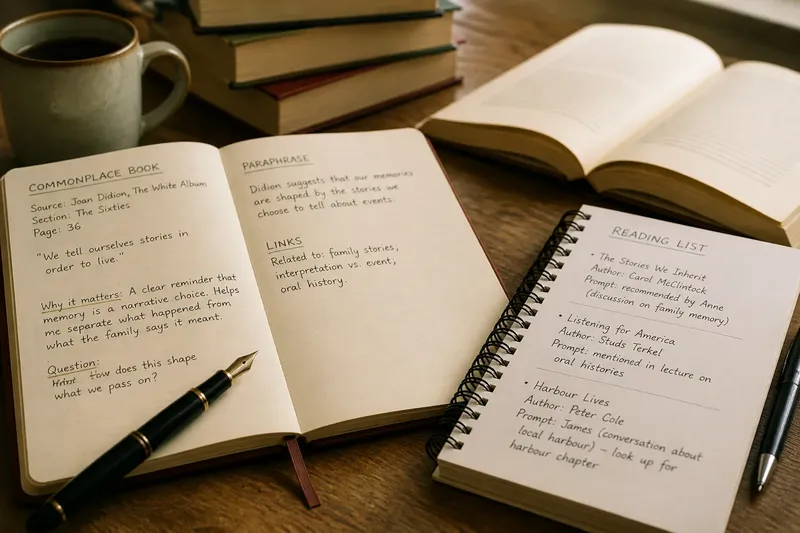
Should you save the striking paragraph you just read, or note the book someone recommended for your next quiet afternoon? A commonplace book and a personal reading list solve different problems: one helps you return to material you have encountered; the other helps you identify a book you may want to open. That distinction keeps useful notes from becoming hard to search.
A commonplace book preserves ideas from reading
A commonplace book is a personal collection of passages, observations and questions gathered from reading. Its purpose is retrieval: to help you recover a thought and the context that made it worth keeping. It can be a paper notebook, a folder of digital notes or a section in a broader journal.
A useful entry includes more than an attractive quotation. Add the source, a location such as a chapter or section heading, and a sentence about what the passage makes you notice. Your own paraphrases and questions belong there too, provided you distinguish them from the source’s exact words.
Imagine you are reading an essay about family stories and encounter a distinction between remembering an event and interpreting it. You copy the relevant sentence, note the essay’s title and section, then write, “Could help me separate what happened from what the family says it meant.” The result is a passage you can trace and a note that explains why it caught your attention.
Paper makes it easy to browse pages and add handwritten connections. A plain-text file or notes app can make searching for a phrase or source simpler. Elaborate tags and decorative layouts are not worth the effort if they slow down capturing a thought you want to keep.
A reading list records books you may want to consider
A personal reading list is a set of pointers to possible books. An entry might begin with a friend’s recommendation, a title mentioned in a lecture, or a subject you want to explore. Include the author if known and a few words about the prompt, such as “mentioned in the discussion of coastal towns”.
Unlike a commonplace book, a reading list does not preserve what a book says. It records enough information to help you find and assess a possible choice later. The prompt matters: it lets you see whether the title still fits the question or interest that brought it to your attention.
Say you hear about a history book during a conversation about a local harbour. You note its title, the speaker’s name and “look up for harbour chapter”. Later, if you are writing about the harbour, that note gives you a reason to investigate the book; if the subject no longer matters to you, it can simply remain unpursued.
A reading list can be grouped by subject, source or current interest. You do not need to rank every title or attach a deadline. If a book stops making sense for your purposes, remove it; if you are unsure, keep the original prompt so you can decide when the subject returns.
Choose the note by what you need to recover
Start with the question you want a note to answer. If you want to find an idea you have already read, record the passage and its context. If you want to remember a book you might choose later, record the title and why it came up.
- You want to quote or develop an idea: record the passage, source and location. If you can identify the passage later, keep that entry; if not, add a clearer location or paraphrase the idea instead.
- You keep forgetting recommendations: record the title, recommender or source, and the reason it was suggested. If the prompt is clear enough to recognise later, leave it; if not, ask for the subject or context before filing it.
- You are reading for a writing project: keep candidate books in the reading list and useful passages in the commonplace book. If a passage supports a specific point, cross-reference the title; if it does not, keep the two notes separate.
- You prefer minimal record-keeping: use one notebook with a clear mark such as “passage” or “possible book”. If you can tell the two kinds of notes apart when browsing, keep one notebook; if they blur together, divide it into sections.
- You want to remember what you finished: keep a reading record with the title and a brief response. If your main question is “What did I read?”, use that record; if it is “What might I read?” or “What should I keep?”, use the reading list or commonplace book instead.
- You have a source but no exact quotation: write a short paraphrase and identify where the idea appears. If that is enough to recover the point, keep the paraphrase; if the original wording matters, return to the source and capture it accurately.
Imagine you are preparing a piece about family memory. You have one note from an essay: its title, the section heading “Remembering”, a short quotation and your comment that it separates events from later interpretations. You also have a recommendation for a book on oral history, with the recommender’s name and the reason they mentioned it. Put the essay passage in your commonplace book because it preserves an idea already encountered; put the oral-history title on your reading list because it is a possible next source. If you later read the book and find a useful passage, add that passage to the commonplace book and link it to the title. The two records now answer different questions without duplicating each other.
How should you record and retrieve each kind of note?
What belongs beside a saved passage?
Record the source, a location you can recognise and a short note about why the passage matters. If you quote exact wording, mark it as a quotation; if you paraphrase, make clear that the phrasing is yours.
Should a commonplace book contain more than quotations?
Yes. Questions, paraphrases, observations and links between ideas can all help you think with what you have read. Keep the boundary between the source’s words and your own clear enough to understand when you return.
How do you keep a reading-list entry useful?
Include the title, author if known and the prompt that brought it to your attention. If the prompt no longer makes sense, look up the subject before deciding whether the book still belongs on your list.
Can one notebook serve both purposes?
Yes, if you can distinguish past reading from possible future reading. Use separate pages, sections or simple labels; if you cannot find the kind of note you need, split the collections or change the labels.
Keep the two collections connected without copying everything
A simple cross-reference can link a candidate book to an idea without turning either collection into a catalogue. For example, the reading-list entry can mention “possible source for the note on family memory”, while the commonplace entry names the book where you found a passage. Add the link only when it will help you move between the notes.
Choose passages carefully. A short quotation with a source and a clear reason for saving it is often easier to use than a page of copied text. For longer material, a concise paraphrase and a location note may serve you better. The aim is to preserve a thought you can find and understand, not to reproduce a book inside your notebook.
Return to each collection when it can answer a real question
Open a commonplace book when you are writing, following an idea or trying to trace a useful argument. Consult a reading list when you want to choose a title or remember why someone suggested it. You can also browse either collection without a fixed schedule; a note is useful when it helps with the question in front of you.
Commonplace books and reading lists serve different jobs: one keeps material you have already encountered, while the other helps you identify a possible book to read. Choose the format according to what you need to recover, and make the source or prompt clear enough to guide your next decision. A modest, findable note will do more for you than an elaborate system you rarely open.